
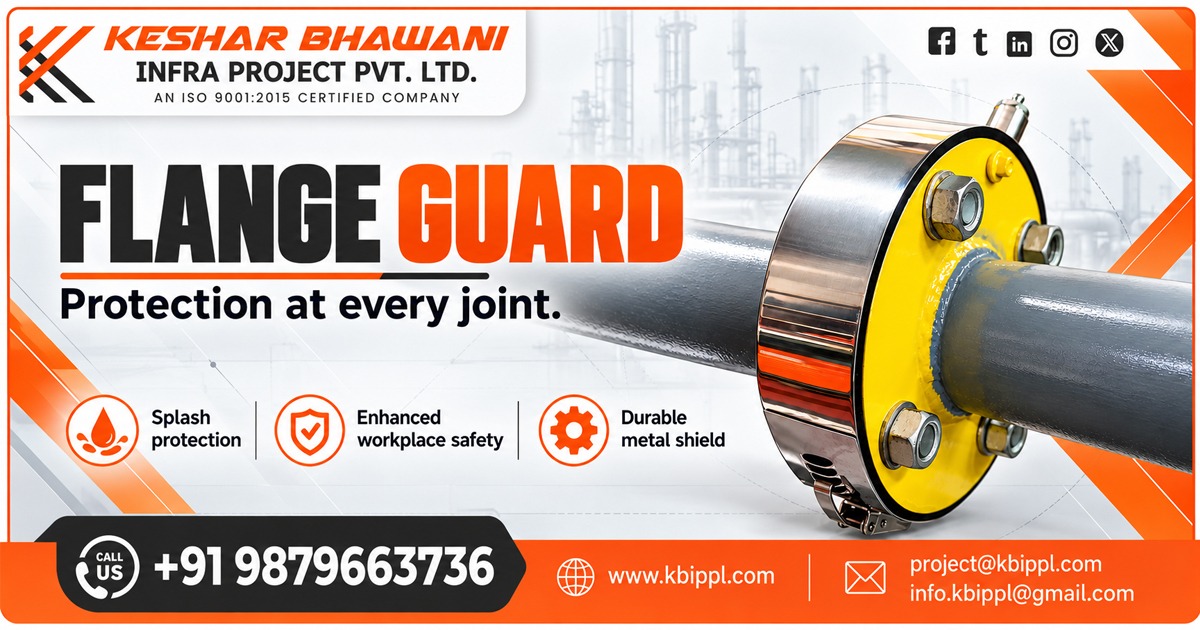
Industrial pipelines and flanged joints may carry chemicals, water, steam, or other process fluids. Selecting a suitable flange guard helps address splash exposure risks around connections. For buyers seeking a Flange Guard Supplier In Maharashtra, Keshar Bhawani Infra Projects Pvt. Ltd. can be approached to discuss project requirements and product suitability.
1. Why Flanged Connections Need Splash Protection
Flanged joints allow pipelines to be connected, inspected, and dismantled for maintenance. However, if a joint develops a leak or fails, the escaping fluid may splash onto nearby equipment or personnel.
A flange guard is a protective covering fitted around a flanged connection to help control or redirect accidental spray, depending on its design and compatibility with the fluid. It is particularly relevant where pipelines carry corrosive or hazardous chemicals.
A flange guard does not replace proper flange assembly, suitable gaskets, pressure control, or routine leak inspections. It should form part of a wider pipeline safety plan.
2. Match the Guard Material to the Process Fluid
Material compatibility is one of the most important purchasing considerations. A guard suitable for one chemical may not be appropriate for another.
Before selecting a product, confirm:
- Chemical compatibility: Check the fluid’s composition, concentration, and operating temperature against the proposed guard material.
- Pipeline conditions: Consider the pressure, temperature, and potential leak exposure around the joint.
- Environmental conditions: Review exposure to sunlight, moisture, outdoor weather, and surrounding chemicals.
- Inspection requirements: Select a design that allows the flange area to be checked without unnecessary difficulty.
Buyers should obtain material compatibility information from the supplier or manufacturer rather than relying on appearance alone.
3. What Should Buyers Confirm Before Ordering?
When evaluating a Flange Guard Supplier In Maharashtra, share the technical details of the intended installation. This helps avoid ordering a guard that does not fit the joint or suit the process conditions.
Prepare the following information:
- Nominal pipe size and flange dimensions.
- Flange type and connection arrangement.
- Fluid name and chemical concentration.
- Normal operating temperature and pressure.
- Indoor or outdoor installation conditions.
- Required guard material and preferred fastening arrangement.
If the pipeline has unusual dimensions or limited surrounding space, discuss the installation layout before finalizing the order.
4. How to Check Product Quality and Suitability
A flange guard must fit the intended connection and remain suitable for the process environment. Buyers should review more than the quoted price when comparing suppliers.
Check the material identification, dimensions, construction, fastening method, and compatibility documentation. Ask whether the proposed design suits the specific flange arrangement and whether the guard can be removed or inspected when maintenance is required.
For critical chemical lines, clarify how the guard is intended to handle accidental leakage. Some designs help redirect spray, while others provide a different form of splash containment. Their suitability depends on the design and application.
5. Installation Planning Around Existing Pipelines
Installation planning should consider nearby valves, pipe supports, instruments, walkways, and other equipment. A guard that fits the flange but obstructs access can make routine inspection more difficult.
Before installation, verify that the pipeline is isolated and depressurized according to the site’s approved safety procedures. Follow the relevant installation instructions and confirm that the guard does not interfere with the flange joint or other safety equipment.
After fitting, inspect the arrangement for proper positioning, secure fastening, and accessibility. Any maintenance work should follow the plant’s established procedures.
6. Common Purchasing Mistakes to Avoid
Several purchasing decisions can create avoidable problems:
- Selecting material without checking its resistance to the process fluid.
- Ordering by nominal pipe size without confirming the actual flange arrangement.
- Ignoring temperature and environmental exposure.
- Choosing a design that obstructs routine inspection.
- Assuming every flange guard provides the same level of splash protection.
- Failing to discuss replacement requirements and technical documentation.
A clear specification shared before ordering can help buyers compare suitable products and reduce the likelihood of an incorrect selection.
7. Services
- Flange guard requirement assessment based on pipeline and process conditions.
- Product selection guidance for suitable material and flange dimensions.
- Assistance with project-specific requirements and installation planning.
- Technical coordination for product documentation and replacement enquiries.
8. Location
Maharashtra has several industrial and chemical-processing centres where pipeline protection is relevant to plant safety and maintenance planning. Buyers can explore requirements associated with Mumbai, Navi Mumbai, Thane, Pune, Pimpri-Chinchwad, Chhatrapati Sambhajinagar, Nashik, Nagpur, Kolhapur, Sangli, Solapur, Satara, Ahilyanagar, Jalgaon, Amravati, Akola, Ratnagiri, Raigad, Palghar, Taloja, Tarapur, Patalganga, Roha, Chakan, and Ranjangaon. Product selection should reflect each site’s process fluid, pipeline configuration, and operating environment.
9. Planning Your Requirement With Keshar Bhawani Infra Projects Pvt. Ltd.
Keshar Bhawani Infra Projects Pvt. Ltd. can be contacted to discuss flange guard requirements for industrial pipeline projects. Buyers should share flange dimensions, fluid details, operating conditions, and installation constraints to support a more informed product discussion.
The company’s manufacturing support is based in Ahmedabad, Gujarat, India. Visit the company’s website to explore its industrial product offerings and discuss the suitability of a proposed solution. Confirm product availability, material options, customization feasibility, and technical support directly before placing an order.
Frequently Asked Questions
Q1: How do I select a flange guard for a chemical pipeline?
A: Start with the chemical composition, concentration, temperature, and flange dimensions. Verify the proposed guard material’s compatibility and confirm that its design suits the expected splash exposure.
Q2: Can one flange guard fit different flange sizes?
A: Compatibility depends on the guard’s design and specified size range. Confirm the actual flange dimensions and connection arrangement before ordering.
Q3: Does a flange guard prevent flange leakage?
A: No. A flange guard is intended to provide a form of splash protection; it does not repair or prevent a leaking joint. Correct assembly, suitable gaskets, inspections, and maintenance remain essential.
Q4: What information should I send to a supplier for a quotation?
A: Provide the pipe and flange sizes, fluid details, operating temperature and pressure, installation environment, quantity, and any material or documentation requirements.
Conclusion
Selecting a suitable flange guard involves more than matching a product to a pipe size. Material compatibility, flange dimensions, operating conditions, inspection access, and the intended level of splash protection all matter. Industrial buyers in Maharashtra can discuss these requirements with Keshar Bhawani Infra Projects Pvt. Ltd. before finalizing their procurement decision.
Contact Keshar Bhawani Infra Projects Pvt. Ltd. to discuss your flange guard requirements and identify the information needed for product selection.
Call Us: +91 9879663736
Mail Us: project@kbippl.com
info.kbippl@gmail.com
Contact us today for inquiries or to place your order!