
Introduction
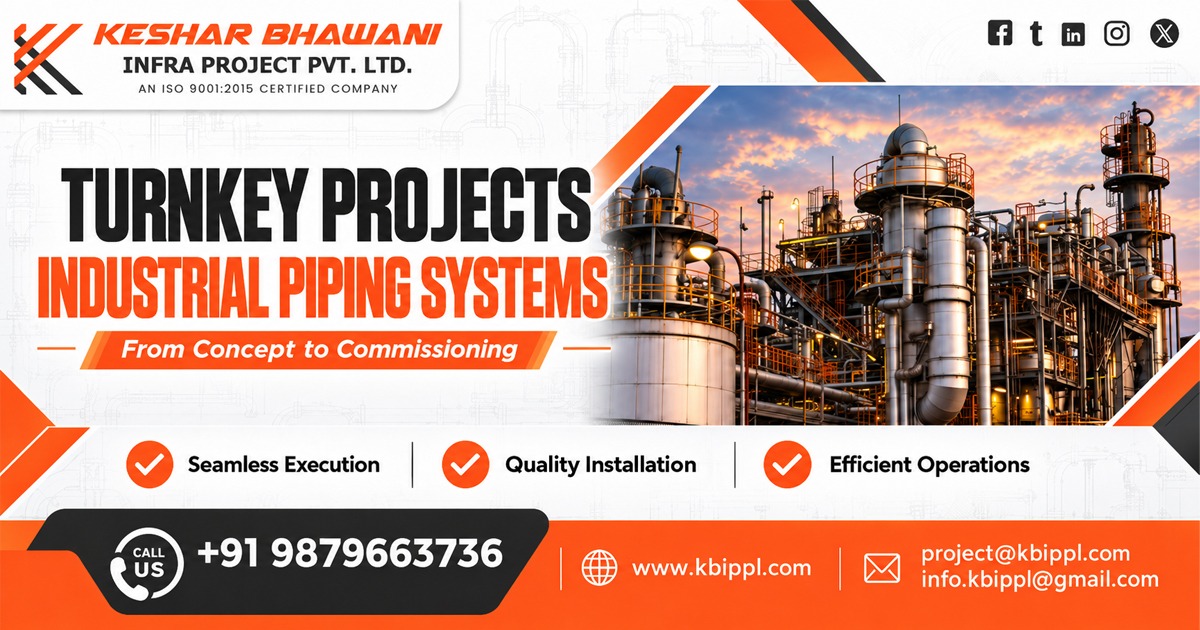
Industrial piping projects can become difficult when fabrication, fittings, installation, utilities, site conditions, and commissioning are handled separately. A turnkey approach brings these activities into one coordinated project scope, helping buyers plan piping requirements more clearly.
Where Does a Turnkey Piping Project Actually Begin?
A piping project should begin with the process requirement, not simply with pipe selection.
Before fabrication starts, the project team needs to understand:
- What fluid or material will move through the system?
- Where will the piping start and end?
- What operating conditions must the system handle?
- Which process and utility lines are required?
- What existing equipment or structures must the piping connect with?
- How much access is available for fabrication, erection and future maintenance?
For a new plant, these questions can be addressed during project planning. For an existing facility, the requirement may involve modification, expansion, replacement or rerouting of an existing network.
What Should Be Defined Before Fabrication Starts?
A well-defined piping scope reduces avoidable changes at the site.
The buyer and project team should establish:
- Process requirement – Identify the service and intended flow path.
- Material compatibility – Select suitable piping materials according to the service and operating environment.
- Routing – Plan the pipe route around equipment, structures, walkways and maintenance areas.
- Fittings and valves – Identify the required bends, reducers, flanges, valves and associated components.
- Supports – Consider how the piping will be supported and connected to the surrounding structure.
- Site conditions – Check available space, access, existing lines and installation constraints.
- Testing and commissioning – Define the checks required before the system is put into operation.
How Does Turnkey Execution Help During the Site Stage?
Turnkey execution becomes particularly useful when several activities must move together.
A typical project flow can include:
Requirement assessment → Engineering/planning → Material and component selection → Fabrication → Site erection → Connection and modification → Testing → Commissioning
The advantage is coordination. Fabricated piping must match the actual site requirement, fittings must suit the planned connections, and installation activities must be scheduled around other construction or production work.
For an operating plant, coordination is even more important because piping work may need to be planned around shutdown windows, existing equipment and restricted working areas.
Keshar Bhawani Infra Projects states that its industrial piping and fittings work includes fabrication, installation, modification and maintenance, along with process and utility piping systems.
Which Project Details Can Change the Piping Requirement?
Two factories may need similar piping systems but still require different project approaches.
Important variables can include:
- Type of process or utility service
- Pipe routing and available space
- Existing plant layout
- Connection points
- Operating environment
- Required valves and fittings
- Support arrangement
- Accessibility for inspection and maintenance
- New installation versus modification of an existing system
- Coordination with civil, structural and other plant activities
The right supplier therefore needs to understand the complete project context before finalizing fabrication and installation activities.
What Should Buyers Check When Comparing Piping Project Suppliers?
Price is only one part of a turnkey piping decision.
A practical supplier comparison should examine whether the contractor can coordinate the different stages of the work.
A buyer can ask:
- Can the supplier understand the complete project scope?
- Is fabrication handled according to the project requirement?
- Can the team manage fittings, valves and associated piping components?
- How will site installation be coordinated?
- Can existing piping be modified when required?
- How will testing and commissioning activities be handled?
- Who will coordinate changes that arise during site execution?
- What level of maintenance or post-installation support is available?
The objective is not simply to find the lowest quotation. It is to identify a supplier whose execution approach matches the complexity of the project.
Why Does Maharashtra Require a Location-Aware Project Approach?
Maharashtra has a broad industrial network covering engineering, automotive, chemicals, pharmaceuticals, food processing, electronics and other manufacturing activities. MIDC identifies major industrial clusters across Mumbai-Thane-Raigad, Pune-Chakan-Talegaon-Satara, Nashik-Malegaon-Ahilyanagar, Chhatrapati Sambhajinagar-Jalna and Nagpur-Amravati.
For Turnkey Projects Industrial Piping Systems In Maharashtra, location can influence project planning because site access, existing industrial infrastructure, installation conditions, utilities and coordination requirements can differ from one industrial area to another.
Relevant industrial locations include Mumbai, Navi Mumbai, Thane, Taloja, Ambernath, Patalganga, Mahad, Pune, Pimpri-Chinchwad, Chakan, Talegaon, Ranjangaon, Nashik, Sinnar, Chhatrapati Sambhajinagar, Jalna, Nagpur, Butibori, Kolhapur, Kagal, Sangli, Solapur, Ratnagiri, and Amravati.
MIDC also lists industrial areas such as Chakan, Talegaon, Taloja, Kagal-Hatkanangale, Lote Parshuram, Pimpri-Chinchwad and Ranjangaon among locations with natural-gas pipeline availability, demonstrating why utility planning can be an important part of industrial project coordination.
Planning the Requirement With Keshar Bhawani Infra Projects
Keshar Bhawani Infra Projects Pvt. Ltd. provides industrial piping and fittings project support from Ahmedabad, Gujarat, India.
Its published industrial piping scope includes pipes, valves, flanges, bends, reducers and other fittings, with work covering process piping, utility piping, fabrication, installation, modification and maintenance.
For turnkey pipeline work, the company’s published material also describes project execution from concept through commissioning and includes areas such as water supply and plumbing systems, gas distribution, industrial fluid conveying systems, effluent conveyance, marine piping, irrigation and pipeline rehabilitation.
Services / Support Available for the Project
Four practical areas of support can be considered when planning the requirement:
- Piping Requirement Assessment
Review the process or utility requirement, connection points, routing considerations and site conditions before execution. - Fabrication and Fittings Support
Coordinate piping fabrication and associated components such as valves, flanges, bends, reducers and fittings according to the project requirement. - Installation and Project Coordination
Coordinate site erection, modifications and related activities so fabricated piping fits the planned installation conditions. - Modification and Maintenance Support
Support existing plants where piping needs to be modified, maintained, rerouted or integrated with an updated process arrangement.
FAQs
1. What should be shared with a piping contractor before requesting a project quotation?
Provide the process requirement, piping layout or available drawings, service details, connection points, site conditions and the required project scope. More complete information allows the supplier to assess the work more accurately.
3. Why are fittings and supports important in a turnkey piping project?
Pipes alone do not make a complete industrial network. Valves, flanges, bends, reducers, fittings and suitable supports all contribute to creating a functional installation that matches the planned routing and connections.
4. Can a turnkey piping supplier support projects outside Ahmedabad?
Project availability depends on the specific requirement and site scope. Keshar Bhawani Infra Projects is based in Ahmedabad and publishes turnkey and industrial piping project capabilities for projects across India.
Conclusion
A successful piping project depends on more than selecting pipes and fittings. Buyers should evaluate the process requirement, routing, fabrication, installation, site coordination, testing and future maintenance together. For Maharashtra projects, a clearly defined scope and capable project partner can make turnkey execution easier to plan and manage.
Planning an industrial piping project in Maharashtra? Share your plant requirement, piping scope or project details with Keshar Bhawani Infra Projects to discuss a suitable fabrication and installation approach.
Call Us: +91 9879663736
Mail Us: project@kbippl.com
info.kbippl@gmail.com
Contact us today for inquiries or to place your order!