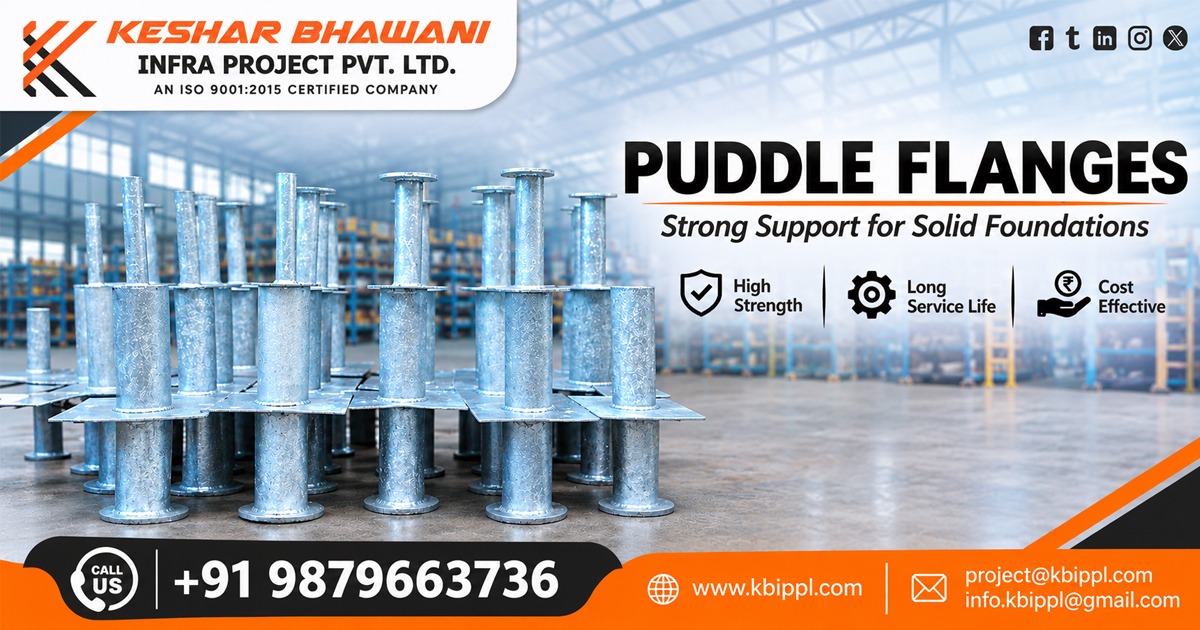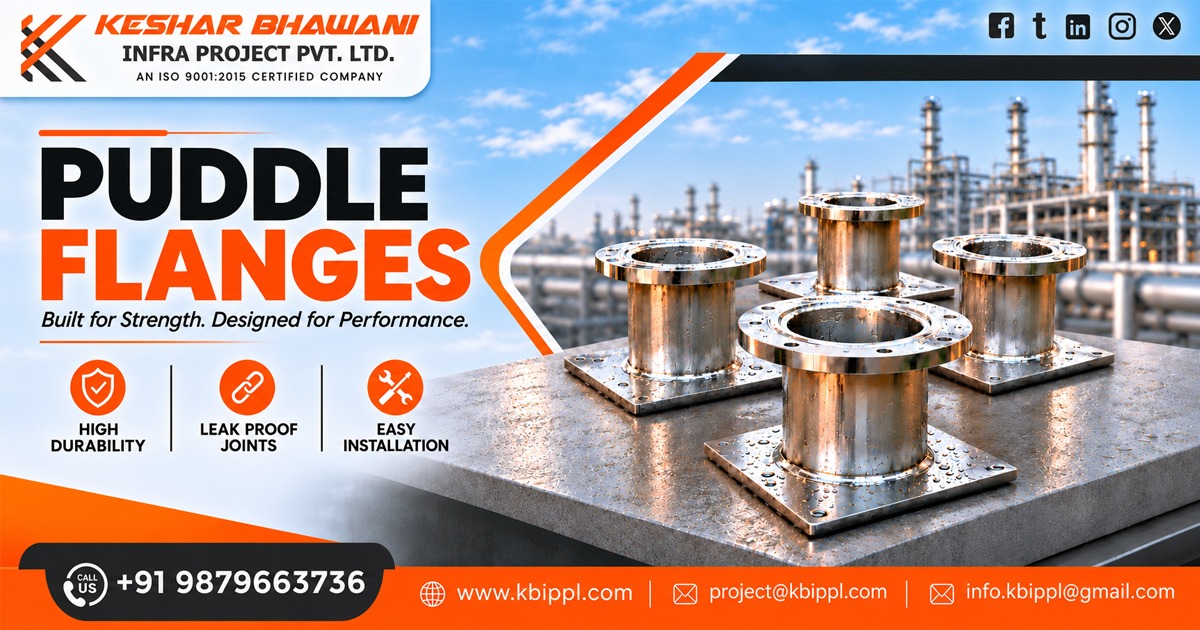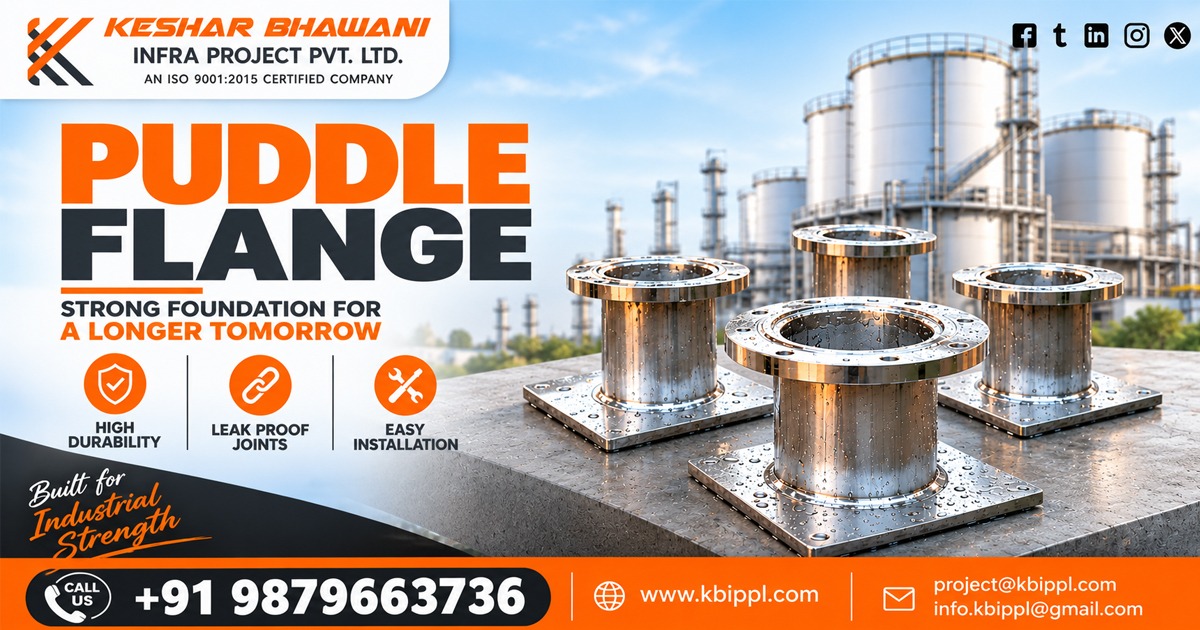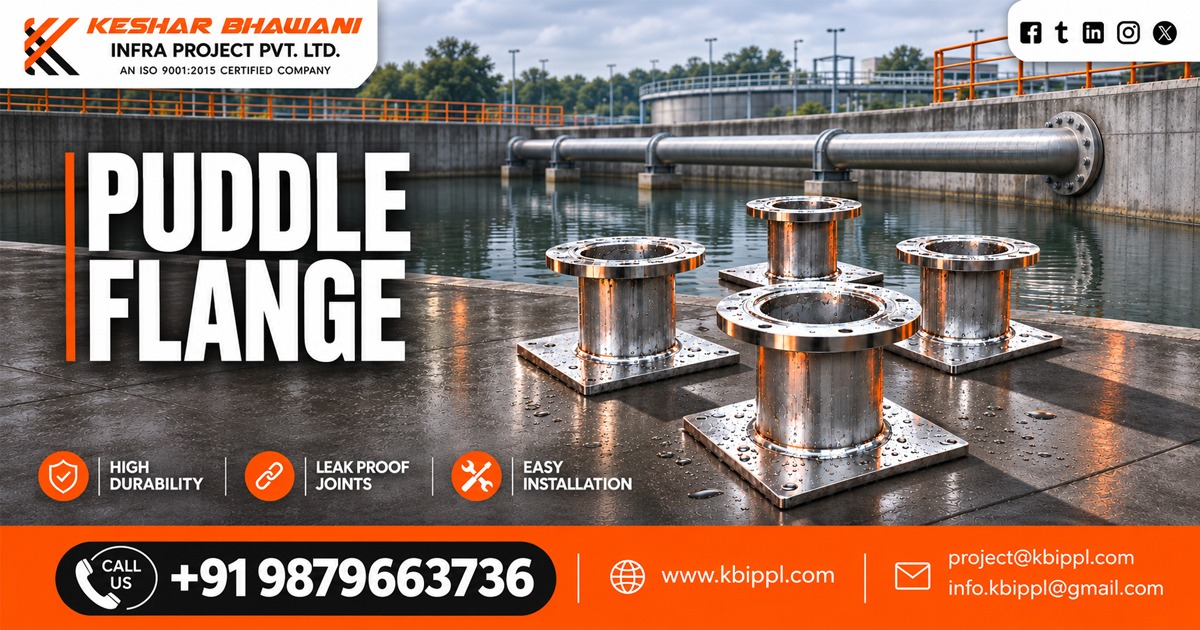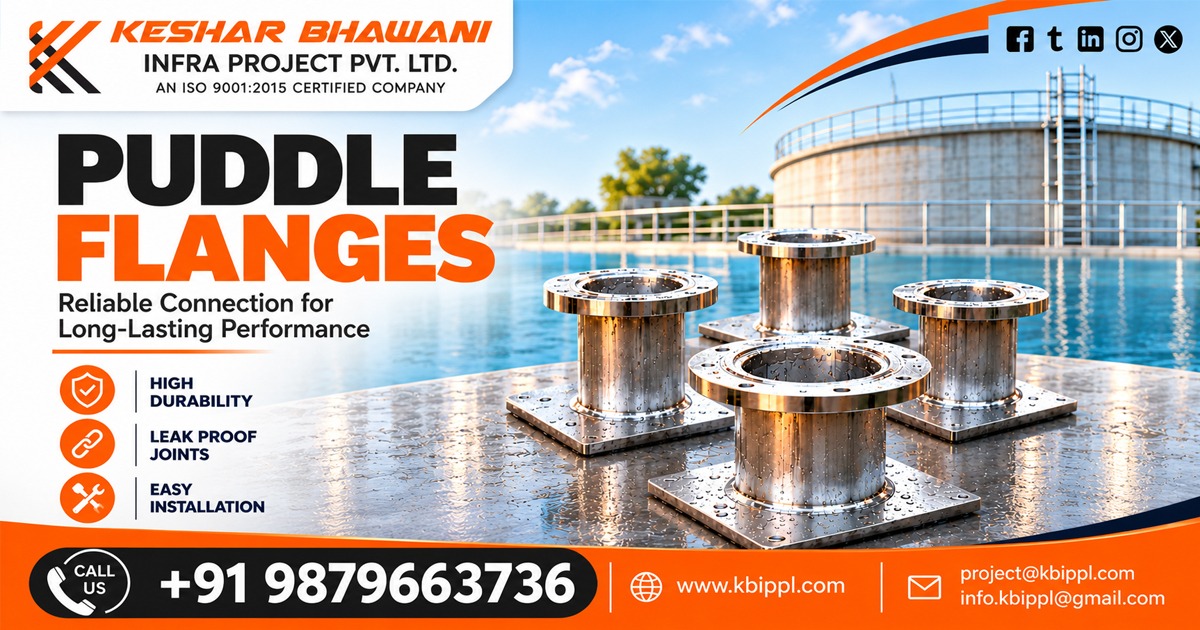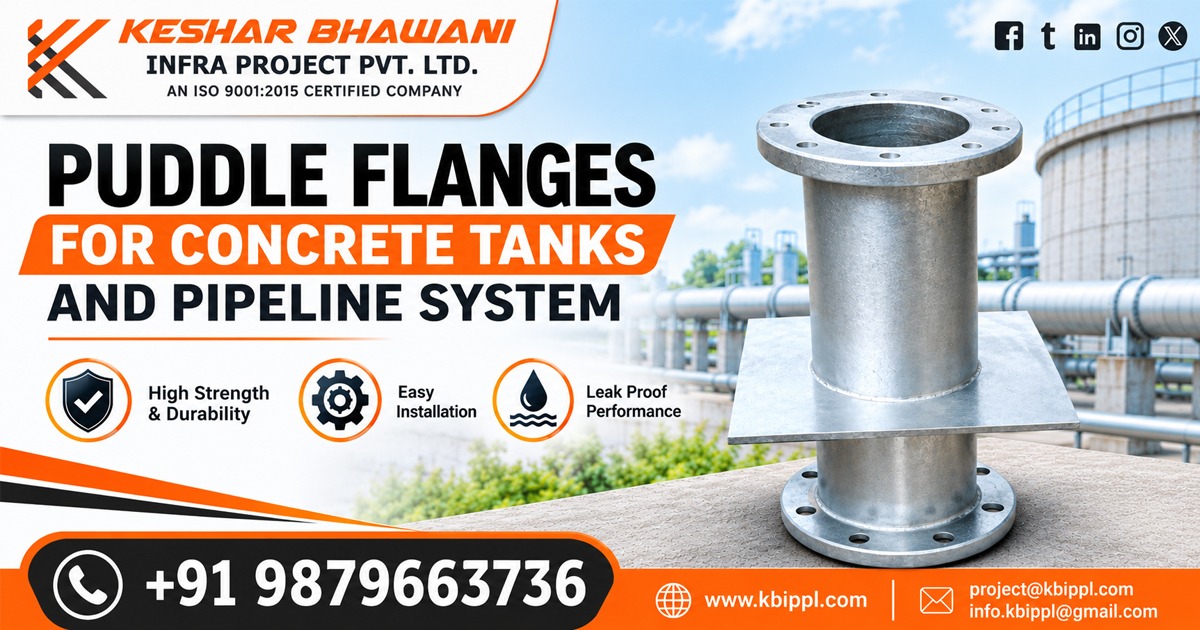


Puddle flanges help prevent water leakage at pipe penetrations through concrete structures. For infrastructure and water-retaining projects, Keshar Bhawani Infra Project Pvt. Ltd. offers a manufacturing-focused approach to MS and SS puddle flange requirements, with manufacturing support from Ahmedabad, Gujarat.
Understanding the Role of Puddle Flanges in Concrete Structures
A puddle flange is a metal plate or collar fitted around a pipe where it passes through a concrete wall, floor, tank, or other water-retaining structure. Its main purpose is to reduce water seepage along the gap between the pipe surface and surrounding concrete.
When pipes pass through concrete without a suitable water-stop arrangement, water can travel along the pipe-to-concrete interface. This may lead to leakage, damp patches, and maintenance problems.
Puddle flanges are commonly considered for:
- Underground water storage tanks
- Sewage treatment plants
- Water treatment facilities
- Pumping stations
- Industrial drainage systems
- Reservoirs and water-retaining structures
- Basement pipelines and utility chambers
The flange creates a barrier within the concrete section, helping restrict water movement around the pipe penetration. It is an important component in projects where maintaining water tightness is a priority.
Selecting the Right MS or SS Puddle Flange
Material and dimensions should be selected according to the pipeline and surrounding environment. Before ordering, project engineers and procurement teams should review the following factors.
| Selection factor | What to check |
| Material | MS or SS based on exposure and project requirements |
| Pipe diameter | Match the flange opening with the specified pipe size |
| Plate thickness | Confirm according to engineering drawings and design requirements |
| Outer diameter | Ensure sufficient coverage within the concrete section |
| Operating environment | Consider moisture, chemicals, and possible corrosion exposure |
| Installation position | Confirm wall, floor, tank, or structural penetration details |
| Welding compatibility | Check compatibility with the pipe material and joining method |
| Project drawings | Verify dimensions and flange arrangement before production |
MS Puddle Flanges: Mild steel options may be considered for projects where the specified design and protective coating requirements support their use.
SS Puddle Flanges: Stainless steel options may be suitable where greater corrosion resistance is required, depending on the grade and operating environment.
Choosing the correct material and dimensions helps avoid installation difficulties and reduces the possibility of water leakage caused by unsuitable pipe penetration arrangements.
How Puddle Flanges Are Installed in Concrete Structures
Correct positioning before concrete pouring is important because the flange becomes embedded in the structure. Installation should follow approved engineering drawings and the project’s waterproofing requirements.
Step 1: Confirm Pipe and Flange Dimensions
Check the pipe diameter, flange opening, outside diameter, plate thickness, and installation position against the approved drawings.
Step 2: Position the Flange
Fit the flange around the pipe at the specified location. Ensure it is correctly aligned with the concrete wall or floor arrangement.
Step 3: Secure the Assembly
Use the specified welding or fixing arrangement to hold the flange in position. The pipe and flange should remain stable during reinforcement work and concrete placement.
Step 4: Complete Concrete Work and Inspection
Check the positioning before pouring concrete. After casting, inspect accessible pipe connections and surrounding areas for signs of leakage during the appropriate testing stage.
Important installation considerations:
- Avoid shifting the flange during concrete pouring.
- Coordinate pipe alignment with civil and plumbing teams.
- Follow the specified welding procedure.
- Ensure concrete is properly placed around the embedded component.
- Check the completed structure according to project inspection requirements.
Quality Checks That Matter Before Ordering
A puddle flange is often difficult to replace after the surrounding concrete structure is completed. Therefore, procurement teams should confirm important details before approving the material.
Consider these checks:
- Material identification: Verify whether the supplied component is mild steel or stainless steel and confirm the specified grade.
- Dimensional accuracy: Compare the pipe opening, flange diameter, and plate thickness with the approved drawing.
- Weld quality: Examine the joint between the pipe and flange for visible defects and confirm the required welding inspection.
- Surface condition: Check for rust, scale, cracks, sharp edges, and surface damage.
- Corrosion protection: Confirm the specified coating or surface treatment for MS components.
- Documentation: Request material details, dimensional inspection records, and other project-required documents.
- Quantity and delivery: Match the order quantity and identification details with the construction schedule.
These checks help buyers identify dimensional or material mismatches before the components reach the installation stage.
Project-Specific Dimensions and Material Coordination
Different infrastructure projects have different pipe routes and concrete arrangements. A puddle flange used in an underground water tank may require a different configuration from one installed in a sewage treatment structure.
Before finalising the order, share the following information with the supplier:
- Pipe outside diameter and material.
- Required MS or SS material grade.
- Flange outer diameter and thickness.
- Concrete wall or floor thickness.
- Welding and connection requirements.
- Surface finish or protective coating.
- Project drawings and quantity requirements.
A Puddle Flanges MS & SS Puddle Flange Manufacturer should be evaluated on its ability to understand the drawing and coordinate the specified dimensions, rather than on price alone.
Any special fabrication or dimensional variation should be confirmed with the manufacturer before production begins.
Services
For infrastructure and industrial piping requirements, the following support areas are relevant:
- Puddle flange requirement assessment and dimensional consultation.
- MS and SS material selection guidance based on project conditions.
- Drawing review and fabrication coordination for pipeline projects.
- Installation planning and technical coordination according to the agreed project scope.
Location: Supporting Infrastructure Projects Across Gujarat
Gujarat has significant requirements for water storage facilities, industrial pipelines, wastewater treatment plants, manufacturing units, and civil infrastructure. Correctly specified puddle flanges are relevant to projects where pipelines pass through concrete structures. Keshar Bhawani Infra Project Pvt. Ltd. provides manufacturing support from Ahmedabad, Gujarat, India, for requirements connected with Ahmedabad, Surat, Vadodara, Rajkot, Gandhinagar, Bharuch, Ankleshwar, Dahej, Vapi, Valsad, Jamnagar, Bhavnagar, Morbi, Mehsana, Kalol, Sanand, Changodar, Naroda, Vatva, Odhav, Makarpura, Halol, Savli, and Kutch.
Why Choose Keshar Bhawani Infra Project Pvt. Ltd.?
Selecting a suitable manufacturer involves more than identifying the required material. Buyers should also consider drawing interpretation, dimensional coordination, product suitability, and project timelines.
Keshar Bhawani Infra Project Pvt. Ltd. includes puddle flanges and pipeline-related solutions in its industrial product range. The company can be approached to discuss project drawings, MS and SS requirements, and product-related enquiries.
With manufacturing support from Ahmedabad, Gujarat, India, it is positioned to coordinate with customers looking for infrastructure and industrial fabrication solutions. Visit kbippl.com to explore its product range and submit your project enquiry.
Keshar Bhawani Infra Projects Private Limited+1
FAQ: Common Questions About MS and SS Puddle Flanges
Q1: What is the main purpose of a puddle flange?
A: A puddle flange helps prevent water seepage around pipes passing through concrete walls, floors, and tanks. It creates a water barrier within the concrete structure.
Q2: Should I choose MS or SS puddle flanges?
A: MS may suit projects with appropriate corrosion protection, while SS may be preferred in more corrosive environments. The final choice depends on material grade and site conditions.
Q3: What dimensions are required when ordering puddle flanges?
A: Buyers should provide pipe diameter, flange outside diameter, plate thickness, material grade, concrete thickness, and relevant fabrication details.
Q4: Can puddle flanges be installed in underground water tanks?
A: Yes. They are commonly used where pipelines pass through underground tanks and other water-retaining concrete structures. Correct positioning and concrete placement are important.
Conclusion
Puddle flanges play an important role in protecting concrete structures from leakage around pipe penetrations. Selecting the correct MS or SS material, dimensions, and installation arrangement is essential. Keshar Bhawani Infra Project Pvt. Ltd. supports project requirements through manufacturing support from Ahmedabad, Gujarat.
Contact Keshar Bhawani Infra Project Pvt. Ltd. through kbippl.com to discuss your puddle flange requirements, material selection, and project specifications.
Call Us: +91 9879663736
Mail Us: project@kbippl.com
info.kbippl@gmail.com