
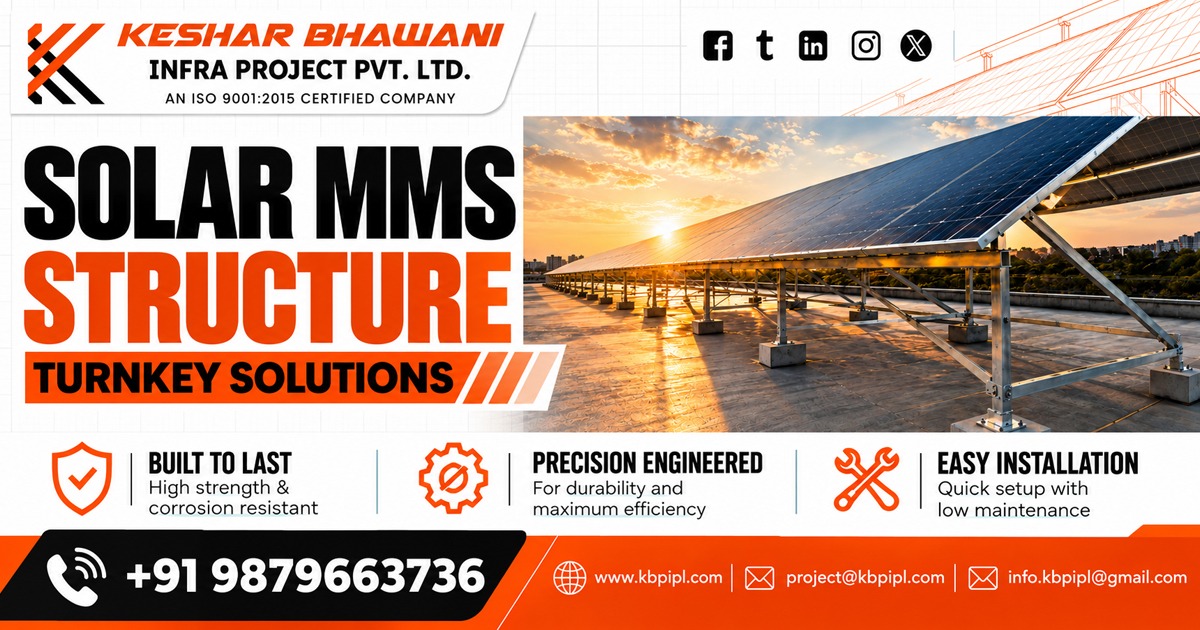
Planning solar projects in Andhra Pradesh requires a mounting structure that matches the site, module arrangement, wind conditions, and installation method. Solar MMS Structure Turnkey Solutions In Andhra Pradesh from Keshar Bhawani Infra Projects Pvt. Ltd. can support project planning from structural requirements through execution.
Start With the Solar Site, Not Just the Structure
The same structural arrangement may not suit every rooftop, ground-mounted plant, industrial facility, or utility-scale installation.
Before finalizing the MMS requirement, buyers should establish:
- Solar module dimensions and mounting arrangement
- Number of modules and planned rows
- Available installation area
- Ground or rooftop conditions
- Local environmental and wind considerations
- Access for installation and maintenance
- Required tilt and orientation
- Cable routing and equipment access
- Future expansion requirements
Structural Decisions That Affect Project Execution
The mounting structure is more than a support frame. Its design influences module positioning, installation time, maintenance access, and the overall project layout.
A project team should discuss the following before placing an order:
Structural arrangement: Determine whether the project requires a ground-mounted, rooftop, or another site-specific arrangement.
Module configuration: The number and orientation of modules per row affect the structural layout.
Material and protection: Confirm the proposed structural material, surface protection, corrosion resistance requirements, and expected site conditions with the supplier.
Connection method: Check how the members will be assembled and whether the proposed arrangement suits the available installation resources.
Foundation interface: For ground-mounted projects, structural design must coordinate with the selected foundation and actual site conditions.
The objective is to avoid designing the structure separately from the solar plant layout.
What a Turnkey MMS Project Should Cover
Different suppliers may use the term differently.
A project discussion can cover:
- Requirement assessment – Review module details, site conditions, installation arrangement, and project scale.
- Structural planning – Develop the required configuration around the agreed module layout and site requirements.
- Manufacturing and supply coordination – Fabricate or arrange structural components according to the finalized requirement.
- Site execution – Coordinate installation, alignment, assembly, inspection, and project handover as agreed in the scope.
Site Preparation Can Prevent Installation Delays
Many installation problems originate before the structure reaches the project site.
For ground-mounted solar projects, the installation team should verify:
- Site levels and accessible working areas
- Foundation locations
- Soil or foundation-related project inputs
- Row spacing
- Equipment movement paths
- Drainage conditions
- Module delivery and storage areas
- Clearance around operating equipment
- Cable routes and maintenance access
For rooftop projects, roof condition, available loading information, access paths, waterproofing considerations, and structural coordination require particular attention.
Installation Sequence Should Be Planned Before Delivery
A properly planned installation sequence reduces confusion when structural components arrive at the project site.
1 – Site verification
Confirm dimensions, foundation points, roof conditions, access, and other agreed site inputs.
2 – Component identification
Sort structural members, fasteners, supports, and related components according to the installation layout.
3 – Base and support preparation
Complete the required foundation or mounting preparation before structural assembly.
4 – Structure assembly
Install the supports and structural members according to the approved arrangement.
5 – Alignment inspection
Check row positioning, structural alignment, connection tightness, and module mounting interfaces.
6 – Module installation
Proceed with module mounting after the supporting structure has been inspected and accepted.
The exact sequence can change depending on the project design and installation method.
Quality Checks Buyers Should Complete Before Acceptance
Purchasing a solar mounting structure only on price can create problems later if dimensions, components, or project scope are unclear.
Before accepting the structure, buyers should verify:
| Checkpoint | What to Verify |
| Material | Confirm the agreed structural material and protection |
| Dimensions | Match supplied components with approved drawings |
| Connections | Check holes, fasteners, joints, and assembly compatibility |
| Module interface | Confirm compatibility with the selected solar modules |
| Foundation interface | Verify support locations against the project layout |
| Surface condition | Inspect for visible damage, coating issues, or corrosion concerns |
| Documentation | Obtain applicable drawings, component lists, and project documents |
| Site installation | Confirm alignment and assembly against the agreed layout |
Common MMS Purchasing Mistakes to Avoid
A few procurement decisions can create unnecessary project complications.
Buying before finalizing module details: Changes in module dimensions or layout can affect the mounting arrangement.
Ignoring site conditions: A structure designed without adequate site information may require changes during installation.
Comparing only the material price: Fabrication, fasteners, transportation, installation, and technical support can influence the actual project cost.
Not defining turnkey scope: Clarify who handles engineering, manufacturing, delivery, installation, commissioning support, and documentation.
Forgetting maintenance access: Rows should be planned with practical access for inspection and cleaning activities.
Not discussing future expansion: If additional modules may be installed later, the structural and site layout should be discussed during the initial planning stage.
Keeping the Structure Serviceable After Installation
Solar MMS structures remain exposed to outdoor conditions, so routine visual inspection is useful after commissioning.
Maintenance planning can include:
- Checking structural joints and accessible fasteners
- Inspecting visible surface damage or corrosion
- Looking for displaced or damaged members
- Checking module mounting interfaces
- Reviewing drainage and surrounding site conditions
- Keeping access areas clear
- Inspecting the structure after severe weather events
- Maintaining records of observations and corrective work
Exact inspection frequency should depend on the site environment, structural design, and supplier recommendations. Any structural repair or modification should be handled by qualified personnel.
Troubleshooting During Project Execution
| Common Issue | Possible Cause | Practical Check |
| Module mounting points do not align | Layout or component mismatch | Compare supplied parts with approved drawings |
| Structure appears out of alignment | Foundation or assembly variation | Recheck reference points and installation measurements |
| Assembly takes longer than planned | Poor component identification or unclear sequence | Organize components according to the installation plan |
| Visible surface damage | Handling or transportation impact | Inspect affected members before installation |
| Fasteners do not match | Incorrect or mixed component supply | Verify fastener list against project documentation |
Services
- Requirement assessment and solar MMS project consultation
- Structural requirement planning and project coordination
- Manufacturing and supply coordination for the agreed structure
- Installation, commissioning coordination, and technical support as defined in the project scope
Solar MMS Support Across Andhra Pradesh
Solar projects across Andhra Pradesh can involve different site conditions, industrial requirements, commercial facilities, and large open areas. Therefore be planned according to the specific project location rather than using one standard configuration. Relevant locations include Visakhapatnam, Vijayawada, Guntur, Tirupati, Nellore, Kurnool, Rajahmundry, Kakinada, Kadapa, Anantapur, Vizianagaram, Srikakulam, Ongole, Eluru, Chittoor, Machilipatnam, Amaravati, Sri City, Krishnapatnam, Hindupur, Kadiri, and Mangalagiri.
Planning the Solar Structure Project With Keshar Bhawani Infra Projects
Keshar Bhawani Infra Projects Pvt. Ltd. can assist buyers in discussing the structural requirement, project scope, manufacturing coordination, and execution requirements for solar MMS projects. The company provides its website information through https://kbippl.com/, while manufacturing support is available from Ahmedabad, Gujarat, India. Project-specific structural requirements, installation scope, and customization should be confirmed during technical discussions.
FAQs
Q: What information is needed before ordering a solar MMS structure?
A: Module dimensions, quantity, layout, installation type, site conditions, required orientation, and project location should be discussed first. This information helps establish the appropriate structural requirement.
Q: Can solar MMS structures be planned for different site layouts?
A: Yes, the structure can be planned around the project’s module arrangement, available space, mounting method, and site requirements. The exact configuration should be finalized from project drawings and technical inputs.
Q: What should be included in a turnkey MMS quotation?
A: Buyers should check whether the quotation covers design coordination, manufacturing, structural supply, transportation, installation, commissioning assistance, documentation, and after-sales support. The exact scope should be clearly written.
Q: How should an installed solar mounting structure be maintained?
A: Regular visual inspection of accessible joints, structural members, fasteners, surface condition, and module interfaces is useful. Maintenance should follow the project design and supplier recommendations.
Conclusion
A solar mounting structure should be planned around the module layout, site conditions, installation method, and long-term access requirements. For projects in Andhra Pradesh, Solar MMS Structure Turnkey Solutions In Andhra Pradesh can simplify coordination when engineering, manufacturing, and execution responsibilities are clearly defined. Keshar Bhawani Infra Projects Pvt. Ltd. can discuss project-specific requirements and support planning from Ahmedabad.
Discuss your solar MMS requirement with Keshar Bhawani Infra Projects Pvt. Ltd. for structural planning, project coordination, and technical assistance based on your site and installation requirements.
Call Us: +91 9879663736
Mail Us: project@kbippl.com
info.kbippl@gmail.com
Contact us today for inquiries or to place your order!