
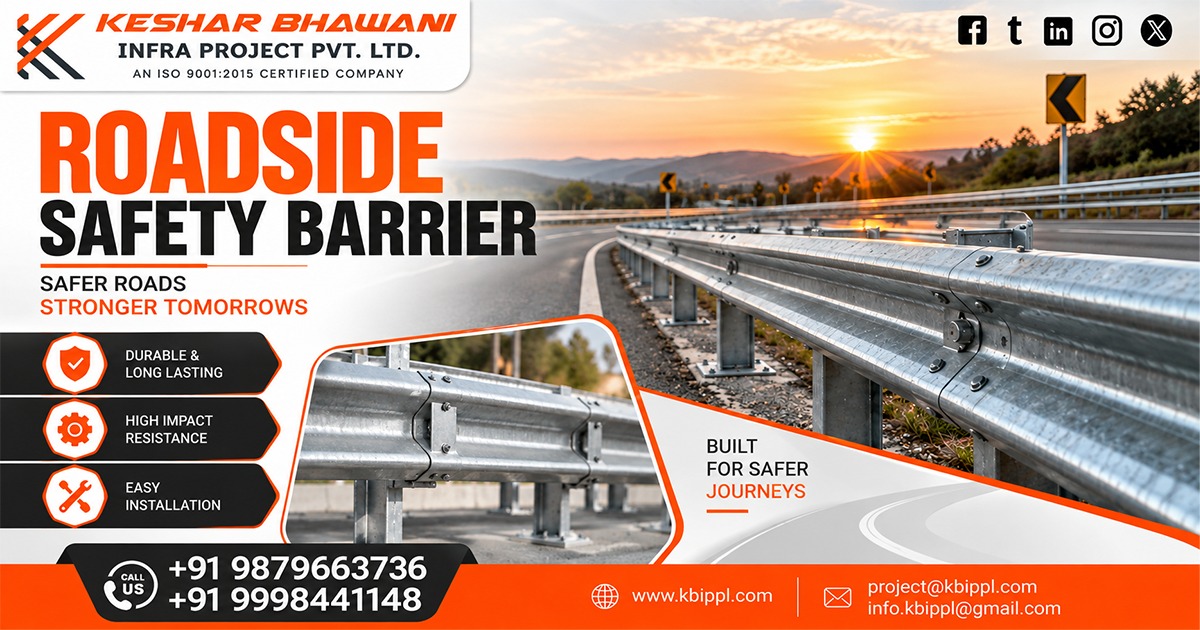
Goa’s highways, bridges, curves, and busy road sections need dependable vehicle restraint systems to reduce roadside hazards. Keshar Bhawani Infra Project Pvt. Ltd. provides roadside barrier solutions for infrastructure requirements, with manufacturing support from Ahmedabad, Gujarat, India.
How Roadside Barriers Help Manage Roadside Hazards
Its primary role is to help redirect an errant vehicle and reduce the severity of a roadside impact.
Common requirements include:
- Highway and road projects
- Bridge approaches
- Curved road sections
- Elevated road edges
- Divided road sections
- Locations near fixed roadside obstacles
Keshar Bhawani’s road-side barrier range includes highway metal W-beam crash barriers and related road safety barrier systems. The company also provides installation and maintenance support as part of turnkey requirements.
What Buyers Should Check Before Specifying a Barrier System
Choosing a barrier should begin with the actual road condition rather than only the product price. Project teams should review:
| Requirement | What to assess |
| Road geometry | Straight, curved, elevated, or approach section |
| Hazard location | Distance between traffic and roadside hazard |
| Barrier layout | Required length, alignment, terminals, and transitions |
| Material | Steel quality and corrosion-protection requirements |
| Environment | Rain, humidity, coastal exposure, and general weather |
| Installation | Foundation, posts, fixing arrangement, and access |
| Maintenance | Inspection access and replacement requirements |
| Project scope | Supply-only or supply with installation |
For Goa projects, environmental exposure deserves particular attention because roadside infrastructure can experience frequent rain and humid conditions.
Understanding the Typical W-Beam Barrier Arrangement
A W-beam barrier generally consists of a continuous metal beam supported by posts and connected using suitable hardware. During a vehicle impact, the system is intended to guide or redirect the vehicle rather than allow it to continue directly toward the roadside hazard.
A typical project sequence can involve:
- Site assessment – Identify hazards, road edges, curves, and available space.
- Layout planning – Mark the required barrier alignment and termination points.
- Post installation – Install supporting posts according to the approved project arrangement.
- Beam fixing – Connect the W-beam sections and associated hardware.
- Alignment inspection – Check continuity, positioning, and fixing.
- Final review – Inspect the completed installation before the road section is placed into service.
The exact arrangement should be finalized according to the project design, applicable road requirements, and site conditions.
Installation Conditions That Can Affect Project Performance
Barrier installation is not simply a matter of placing steel sections beside a road. Site conditions can influence the installation method and final alignment.
Before work begins, the project team should confirm:
- Road width and available working area
- Ground and foundation conditions
- Existing drainage arrangements
- Underground utilities
- Roadside structures and obstructions
- Required safety clearance
- Access for installation equipment
- Traffic-management arrangements
- Barrier termination and transition requirements
Accurate site measurement can reduce alignment problems during installation. Keshar Bhawani Infra Projects describes a project approach involving site inspection, design or samples, followed by installation and commissioning at the site.
Maintenance Checks for Long-Term Roadside Protection
A roadside barrier should be inspected periodically, particularly after vehicle impacts, road construction activity, severe weather, or changes around the road edge.
A practical inspection can include:
- Checking beams for deformation
- Inspecting posts and fixing hardware
- Looking for loose connections
- Checking corrosion or coating damage
- Reviewing alignment after an impact
- Replacing damaged components where required
- Keeping the roadside area clear of unnecessary obstructions
Common Issues and Practical Actions
| Common issue | Possible reason | Practical action |
| Beam misalignment | Impact or external disturbance | Inspect and realign damaged sections |
| Loose hardware | Vibration or impact | Check connections and tighten or replace as required |
| Surface corrosion | Coating damage or environmental exposure | Inspect affected area and plan suitable corrective work |
| Damaged beam | Vehicle collision | Isolate the damaged section and arrange replacement |
| Post movement | Impact or ground condition | Inspect the installation and correct the affected support |
Maintenance should be performed by qualified personnel according to the project requirements.
Quality Checks to Complete Before Ordering
Before selecting a supplier, infrastructure contractors and project owners should verify more than the quoted rate.
A useful buyer checklist includes:
- Correct barrier type for the intended road application
- Beam and post material details
- Dimensions and configuration
- Corrosion-protection method
- Connection and fixing details
- Required quantity and section lengths
- Site installation scope
- Product documentation
- Inspection and testing information where applicable
- Replacement and spare-component availability
- Technical support after installation
A supplier capable of handling both material supply and installation can also simplify coordination for larger road and infrastructure projects.
Services
- Site requirement assessment and barrier planning
- Barrier supply and project-specific configuration
- Installation and commissioning support
- Maintenance and technical assistance
Location
Roadside safety infrastructure is relevant across Goa where highways, urban roads, bridges, tourism routes, and developing infrastructure require controlled roadside protection. Project requirements may vary according to traffic conditions, terrain, road geometry, and environmental exposure across Panaji, Margao, Vasco da Gama, Mapusa, Ponda, Bicholim, Valpoi, Canacona, Quepem, Cuncolim, Curchorem, Sanquelim, Pernem, Porvorim, Calangute, Candolim, Verna, Chicalim, Navelim, Colva, Sanguem, Dharbandora, Assagao, and Bambolim.
Planning Road Safety Projects With Keshar Bhawani Infra
Keshar Bhawani Infra Project Pvt. Ltd. has road-side barriers within its industrial product range and positions itself for turnkey project requirements across India. Its published road barrier information covers highway metal W-beam crash barriers, installation, maintenance, and project-based supply.
For a Goa requirement, the company can support discussions around:
- Site-specific barrier requirements
- Product selection and configuration
- Supply planning
- Installation coordination
- Project execution requirements
- Maintenance support
The company operates from Ahmedabad and provides manufacturing support from Ahmedabad, Gujarat, India. Its website also highlights site inspection, design/sample preparation, and site installation as parts of its broader project workflow.
Frequently Asked Questions
Q: Where are roadside safety barriers commonly installed?
A: They are commonly used along highways, bridges, curves, elevated sections, and road edges where vehicles need protection from roadside hazards.
Q: What should be considered when selecting a W-beam barrier?
A: Consider road geometry, hazard location, barrier configuration, material, corrosion protection, installation conditions, and the applicable project requirements.
Q: Can roadside barriers be supplied with installation support?
A: Yes. Supply can be combined with installation support depending on the project scope. Keshar Bhawani also lists installation and maintenance services for its road-side barrier solutions.
Q: Can the barrier requirement be discussed for a specific Goa project?
A: Yes. Buyers can share road drawings, site details, required length, application, and installation conditions with the supplier for requirement assessment and planning.
Conclusion
A properly planned roadside barrier system can help manage vehicle movement near hazardous road edges, bridges, curves, and other exposed areas. Buyers in Goa should evaluate configuration, material, corrosion protection, site conditions, installation, and maintenance requirements before ordering. Keshar Bhawani Infra Project Pvt. Ltd. can support project discussions with manufacturing support from Ahmedabad, Gujarat, India.
Call Us:
+91 9879663736
+91 9998441148
Mail Us: project@kbippl.com
info.kbippl@gmail.com
Contact us today for inquiries or to place your order!
View Product: Click Here